
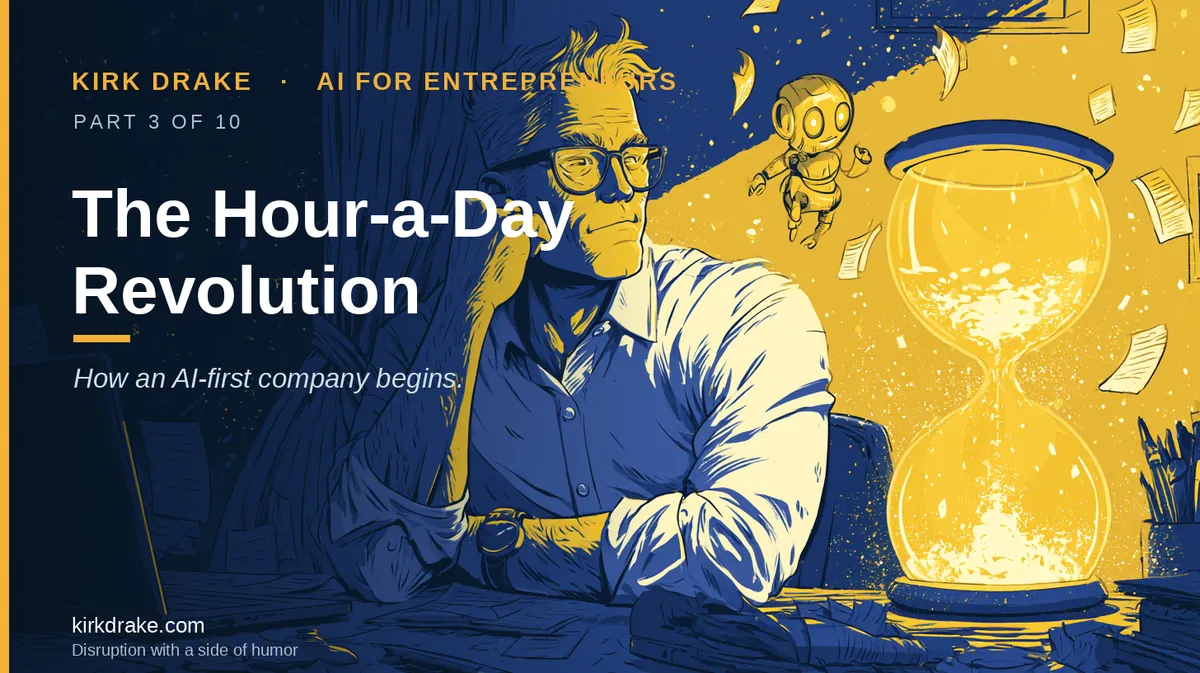
People expect the origin story of an “AI-first” company to be dramatic. A bold bet, a war room, a visionary memo. Mine is less cinematic: somebody on my team realized the task they dreaded every morning now took twenty minutes instead of ninety, and got quietly, deliriously happy about it.
It Started With an Hour
That was the whole of year one. No grand strategy, no platform, no architecture diagram a CFO would respect. Just a simple, contagious fact: everyone started saving an hour or two a day. Multiply a found hour across a team and across a year and you have something powerful — but it didn’t start as a plan. It started as relief.
The Three Things We Got Right
We made prompting a team sport instead of a private trick. People built scrappy little custom assistants for their actual jobs — drafting proposals, untangling a vendor email, turning a 2 a.m. idea into something coherent — and traded them around like recipes. Including the GPT that, for reasons I still can’t explain, insisted on describing our wine in the voice of a pirate. We kept it. Morale.
We wrote one rule, not forty. The rule: AI drafts, a human decides. Anything reversible, let the machine take a swing. Anything that touches a customer, a dollar, or your reputation, a human signs off. That single sentence gave everyone permission to experiment without imagining a catastrophe.
And we celebrated the wins out loud. Every week, someone showed the thing AI saved them. It sounds like a participation trophy, and it was the highest-ROI thing we did all year — total budget, one round of applause. Because “save an hour a day” is an abstraction until you watch a coworker light up about getting their evening back, and three other people quietly think I want that.
Make It Normal First
Year one looks like nothing on a slide. But it builds the only foundation that compounds: a team that reaches for AI on reflex instead of waiting to be told. Everything I’ll brag about in later posts — the apps, the automated companies, the restructure — was only possible because year one made AI normal.
If you’re starting, don’t try to skip to the impressive part. Get your people to an hour a day first. The flashy stuff comes later, and honestly it’s mostly built on that boring little hour.
Final Thoughts
Why It Matters: “Tools don’t transform a company; habits do. An hour a day, made contagious, is the substrate everything else grows from.”
What to Do: Make prompting a team sport, write one rule (“AI drafts, a human decides”), and celebrate the small wins out loud until reaching for AI is a reflex.
Coming Up Next: How that one free hour became three or four — by building AI into the work instead of just using it.
Disruption with a side of humor — Kirk Drake, signing off (until the next post).
The culture piece — making AI contagious instead of threatening — is my favorite thing to talk about on stage. Book me here.
Want this energy at your event?